
a consumer tragedy

"It's better to know one book intimately than a hundred superficially." - Donna Tartt
By last October, I had already rehearsed the idea of the shoes too many times and I'd already turned them over in my head until they felt less like an object and more like a false God. After finally wearing a pair of converse everyday for a year, I was fixated on a pair of Doc Martens at first, the title is with a taste of borrowed grit. I liked the idea of them, pretentious. It was then that I came across those burgundy shoes, the kind with an elevated, thick sole and laces that looked like safety ropes. Their laces looked like safety ropes, absurdly sturdy.
Two thousand isn’t much, I suppose, for a pair of glossy burgundy shoes. It’s the kind of number that barely registers for the people I’m surrounded by, it disappears into café bills and late-night delivery orders, into impulsive swipes made while standing in line or killing time. But two thousand is a lot when it is myself I have to spend it on. When the purchase cannot be further disguised as necessity or convenience. When there is no one else to blame, no external reason to point to. When it has to be justified to yourself, line by line, as though you were arguing a case in court and everytime you look at the thing you've bought, you only feel a sense of dread and the feeling of vomit chemically forming inside.
Because spending on yourself is never just about money. Are you allowed to want something simply because it delights you? Someone else deserves ease more than you do. I imagined the shoes on my feet. I imagined walking more deliberately. And then I imagined the aftermath of the guilt, the self-interrogation, the mental arithmetic of what else that money could have been. It felt sadistic that a pair of shoes could hold so much power. But that is the truth of it.
Two thousand is a lot.
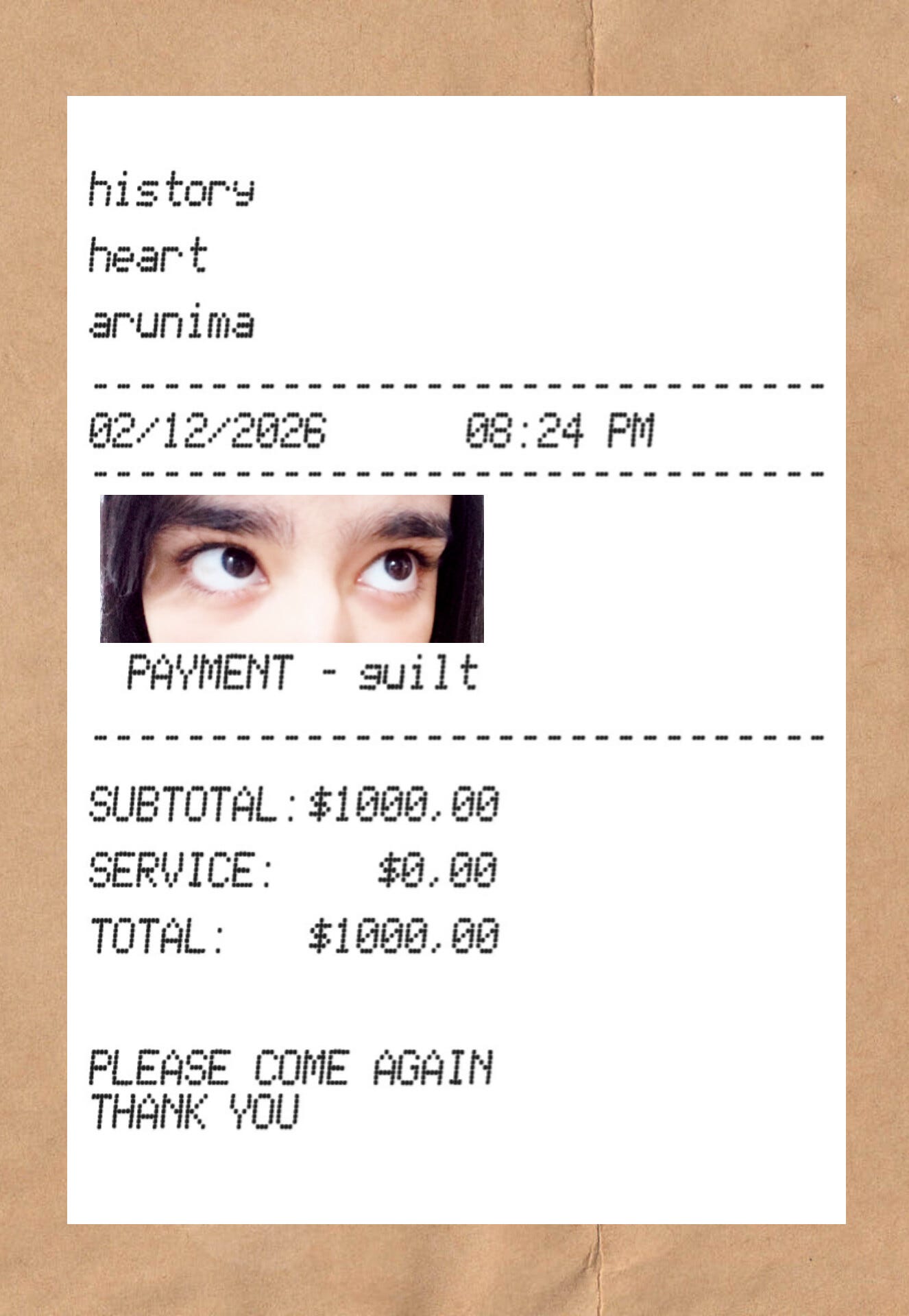
I hesitate when desire is self-directed. There is a particular shame that arrives then, settling in my chest like a forgotten basket, plastic bills folded inside it like relics. I can rationalise spending on textbooks and course requirements. I can justify PDFs, scanned pages, online archives, things that come with the moral seal of necessity. Indulgence, however, feels extravagant when it is personal, when it asks me to admit that I am worthy of pleasure without proof or productivity. Instead i receive a voice inside my head telling me to jump because i should've thought about the family conditions first. And then the loop beings again, another voice telling me that I'm not even pursuing a degree which will drown me in money or hell, even fetch me money. Am i that selfish? Am i that cruel? Am i becoming the girl my mother cursed me to become?
–_–_–––_
I don’t like wobbly lines and I don’t like going over words, but I don’t like sharing my books either— unless you promise to write what you feel all over the margins. It's like you holding the कीप and making flowers with broken stems on my palm with henna that's about to smell ferocious once taken off. It's like i hand you my favourite colouring book and you colour outside the lines and i don't mind. Broken spines, curled covers, patchy pages, baby these are cosmetic injuries. The margins carry your weight for longer than I intend to, for longer than I will be able to. No false oaths. They become a graveyard for all things felt and said and, more importantly, left unsaid. Love letters, poems, apologies I never received, threats i live despite of. My tarnished books house these undead things, seeping into life the way water does, separating us the way distance always did. If consumption is a form of intimacy, then the margin is its most honest record. A tabular structure with your check-ins and check-outs and all the weight you lose in between. Like how a birthday party I went to in 8th grade started a chain of falling dominoes and made me lose 13 kilos until I started falling dead on the ground. Even today when I lie down to sleep, I run my fingers over my ribs through the skin on my chest and there is sort of a bite to it, i suppose.
As for books, I would have lent you a copy, but lately I’ve been reading off PDFs and the internet archive. The paperbacks I fall in love with are too expensive these days. Worth it perhaps but I’m no longer sure my pocket allows me to buy as my appetite demands. Coursework requires physical copies anyway, so whatever I read for indulgence is consumed digitally, without the luxury of touch. The last time I bought an expensive book was on my eighteenth birthday, the unabridged journals of Sylvia Plath, for a little under a thousand. I don’t regret it at all, which is surprising, considering how quickly I grow resentful of things that further categorise me as an expensive child. I do not regret Plath at all.
It is Plath, those movies i know by heart, those videos i fall back to, my old ways, my old habits, my old—
It is to them only i surrender myself. The media i consume ardently is the media i succumb to. A single line can hold me hostage for days. My preoccupation with a lyric, a quote, a dialogue, and a tune even is what feeds vitality and meaning into my life. I am more when i allow myself to know more. I am legitimate only when i let myself indulge, if not in commodities and glosses atleast in knowing that there's always more to learn, that there exists a pool of knowledge and entertainment and comfort out there unbeknownst to me.
The media I consume is never passive. I like to think I’m the one choosing what to watch, read, scroll through, replay. But those choices begin choosing me back. I absorb more than plot. Media shapes how I understand love. What I repeatedly consume becomes the emotional template against which I measure my own life. It shapes my sense of self-worth too. When I’m constantly surrounded by success, perfect bodies, perfect grades, perfect lifestyles, I start to feel perpetually behind. But media can also be liberating. Seeing someone who looks like me, thinks like me, struggles like me or someone who is so entirely different that it does nothing but fascinate me.
And yet, media saves me too. I become what I repeatedly expose myself to. So what consumes me is the thought of you, the thought of failing, the thought of starvation, the thought of being a burden, the thought of losing my sense of purpose, and the thought of hating what I once wanted and on the other hand is what I consume. And what I consume is just an attempt to feel something in return. Transactional, i suppose.
My earliest memories of consumption are musical. Music, i feel, is discovered then rediscovered and stays for longer than people.
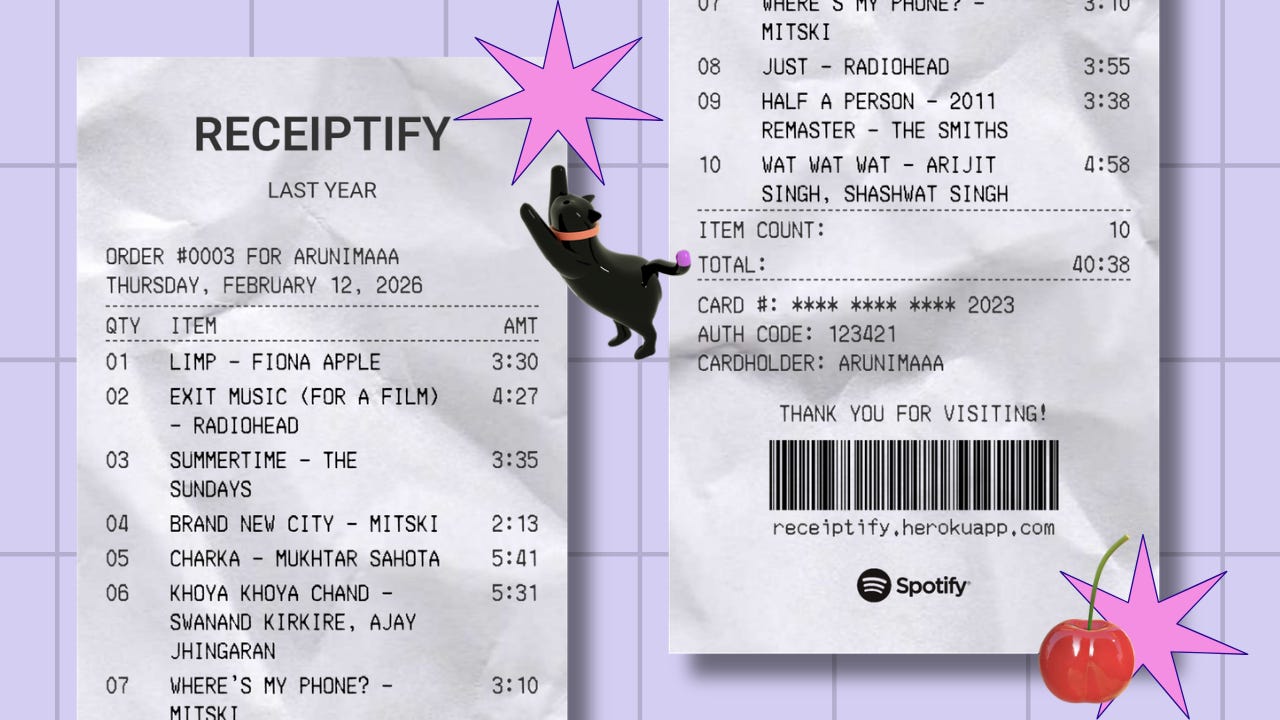
“Aao tumhe chaand pe le jaayein.” The setting is fixed in my mind: my beautiful mother, winter in Delhi, Christmas week. The room smelled faintly of cold cream and agarbatti. When we were younger, we celebrated Christmas traditionally. A fake tree strung with stars and lights, dolls and cars wrapped in glitter sheets. At night, tucked into cotton razais, mummy would sing us Jingle Bells and then follow it with this song. For years, I believed this was how the song ended. That somewhere in the original English lyrics, after the sleigh and the snow, there was a promise to take you to the moon. In my memory, they are indivisible: a sleigh ride that lifts unexpectedly into the sky, a bell that rings until it becomes a lullaby. The inevitable desire of reaching the moon. This is how my mother edited the world for me, she removed the seam.
“Ek ghar banaaunga tere ghar ke saamne.” Love felt easier when I was younger, perhaps because its introduction was so inconvenient. It came through late-night television shows hosted by Annu Kapoor, where he played songs and spoke about them. These songs promised simple, legible futures. Their origin stories, which my mother repeated to us, took on the seriousness of science. This routine lasted until my father said he hated music, tears in his eyes until I grew afraid to sing aloud. Love, too, became cautious in my imagination. The fairy tales blurred.
500 Miles, Country Roads, Blackbird. The classroom was on the top floor of the building, set apart from the rest of the school, officially designated for music. My brother and I enrolled in the same club that year, and in hindsight, it is strange how instinctively we clung to each other. We bailed on friends to eat lunch together. I wandered into his classroom unannounced; he joined the club simply to prolong our togetherness. That was also the year a new music teacher arrived. He had long hair and carried a guitar and I remember the guitar more vividly than I remember his face. He made us sing these songs, asked us to go home and learn the lyrics. Through him, I encountered music that would later feel like landmarks in my life. At the time, they seemed simple. Only later did I understand how deeply they lodged themselves into me. When the entire class sang together, something in me knew it would become a core memory. And it has. I don’t remember the teacher’s name, or how long he stayed. Those details have dissolved. The music has not. It remains suspended somewhere beyond memory’s erosion. People leave, rooms change, the music is eternal.
"With God on Our Side." I think my attachment to this song rests somewhere between my desire to change and my fear of it, and also in my deviation from God. Take my side sometimes, old man.
"Goodbye Yellow Brick Road." I would have given everything in my power to feel what I felt the first time I heard it. Life changed. It felt right. I wanted nothing more than to run away. I told K about this song, and we listened to it endlessly. If magic exists anywhere, I think it lives inside that melody.
Hurt, Iris, The Sound of Silence, The Unforgiven, Comfortably Numb. I used to wash my hair, lie in the afternoon sun, and play this very specific loser playlist. I felt like a loser. I cried to those lyrics for a long time, until one day I stopped crying altogether. I grew numb. I became ordinary. Somewhere along the way, I lost my hobbies, and with them the part of myself that could feel things fully. I would never wish to return to that version of myself. I wouldn’t wish a coaching centre on my worst enemy. I do not want to talk about that year anymore.
Do we, as people, consume other people too, in the most non-cannibalistic way possible? Or do we end up being consumed by them? Is there a hierarchy to this process? Does the lacking consume the excess, or the insufficient latch onto the sufficient like leeches, like parasites, like devotees? Devotion, after all, is another kind of hunger. It is hunger wearing good manners and a countenance of an aristocratic widow. But if such a proof exists, then I believe I have consumed people my entire life, and that no one has ever needed to consume me. I have always been the one lacking, the one borrowing, the one assembling myself out of other people’s music, language, courage, and certainty. Which is why I sometimes think of myself as unethical plagiarism, and that is if humans can be plagiarised at all. I am a chameleon changing colours, a rabbit sprinting from one stone to another. A mosaic of all you love, they call it now. I have munched my way upward, if there is a chart we are climbing.
[Redacted] consumed my thoughts, I consumed [redacted]'s lust. And so it has been for every other relationship. And so it will ever be until the romantic inside me collides with someone who doesn't need to take away something from me and i don't need to take away something from them. A fair displacement reaction, i propose, would be even better. One where nobody lacks and nobody is surplus.
Anyways the damned shoes are out of stock now. Man, I really wanted those burgundy shoes.
xx
beautiful i have no words, the way you transition seamlessly is insane, when I'm reading you, the world around me pauses. you're a genius as i always say and will continue to do so 🩷🩷
how vividly you describe ache of desire and weight of self judgement. from shoe, to consumerism, then books and music you consume and again ending with shoe. i love this transitions. you are genius. you are splendid aruuu!! Loveee loveee loveee