
carnal desires

TW (!)
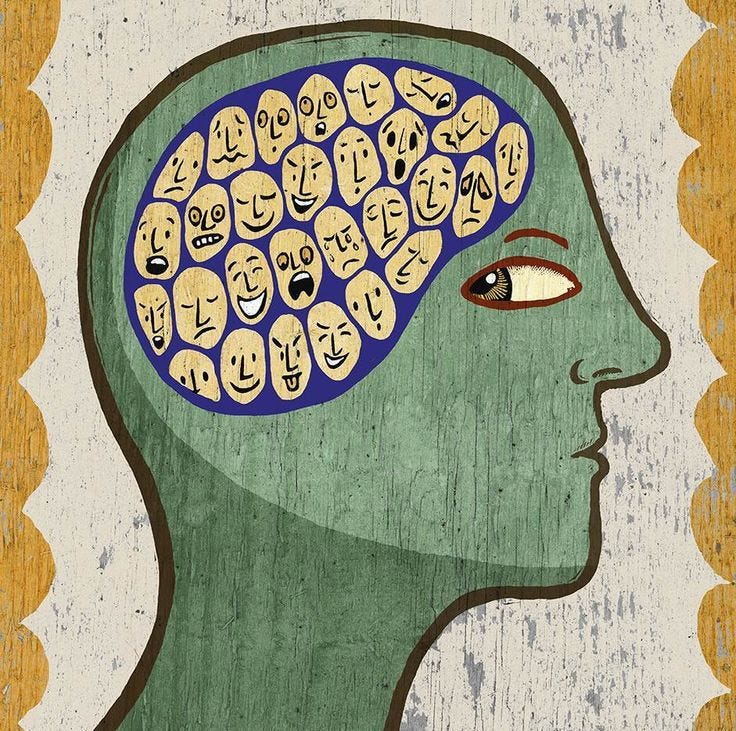
9 down. I ate whatever I killed.
Almost air dried and taking shape like fine lines on cracked porcelain, there were crimson hues like a cheap cosmetic tint I had bought which looked rather patchy on my lips. I glide my tongue over the disgusting sticky scarlet breeding in the gap between my teeth as i fondle my two red locks drenched in sweat and other bodily fluids. Inside my mouth it tastes like a stale rust infection, like the plagued heart of the face which launched a thousand ships, or how lucifer's pair of burnt autumnal wings would have tasted. And it is this aftertaste that is the worst. At the sight of my mouth which looks like a lion's violent fur after a feast, i feel my sloppy tongue go numb and obsolete, and my jaw tighten in a square. I look down at my bloated belly filled with intestines and liver that weren't mine, and it looks like an impious tumor growth from those late-night life-saving obscure finds on the midnight medical program series that ran on discovery channel. I turn to my left and my body resembles that of a boa snake after having swallowed an elephant whole. Naturally it is my body which tires me and not the act of devouring another. With my thick skin pressed against the tiles, I slept on the cold floor of my balcony when the sky was red too with the weight of the new dawn rising on its banks.
My boxy appartment faces my husband's office. The word “husband” implies a continuity that has clearly been broken, yet I find that I cannot replace it with anything else. I look at the sheer glow of dawn resemble the colours of ripe mangoes and peak like biblical halos from behind the postmodern structure of a world famous firm. But I have no idea what goes on behind the windows that don't reflect light, that don't glisten, and that are never dirty. When it's 9 minutes past 4, he leaves on his two feet covered in faux leather and is met by a silver car he bought with a decent budget two summers back. Two entire city summers back, one could say that we weren't even together. But i feel it my failing nerves that we still are, we're still one unit no matter how far his bare back is from me. Sometimes it's only our ring that i wear when i look at him leave. Our ring refracts the dying sun. And i watch him depart with false vows wrapped around his finger, still, after all time. He doesn't come back home because he's not welcome here anymore. Though i do think my temper would've been better if he were still the man I knew. This man who i watch everyday is a foreign concept to me now. Still, I feel it in my nerves and my throbbing ring finger dented with the band, that he belongs to me in a way this unfair distance cannot correct. This man, this version of him, this grey stranger in polished shoes— he ate my baby. I have visions of my baby being outside my body and us being tied together with a thick slimy cord. I have visions of of it being so far away.
September, last year, i called up his woman. He's going to eat your baby as well. You must protect your baby. You must not end up like me. And I tried to paint a picture for her, of me laying on the balcony floor with my dead baby in my hands squeezed tight to share warmth, but she hung up. September, last year, became the last time my husband looked me in the eye. The next day he took his reading glasses off and looked upwards in the direction of our appartment, somehow knowing all this time that i had been looking at him completely naked. The look in his eyes and the frowning face and the stiff brows, none of it made sense. He wasn't looking at me, finally acknowledging me, to threaten me and neither was he in love with me. Between the two extremities, his feelings towards his ex wife suspended mid air. Had he been surprised that i would dare to call her up? Had he been disappointed that i dragged our baby in the conversation? Did she not know that he had eaten a baby before? None of my questions were answered through his gaze, i was rather left even more perplexed. I didn't know if i hated him after all that, or that i never loved him to begin with.
I can smell my baby when i curl up as i sleep. The weight of something that almost was. I was getting used to it, carrying someone else's weight as mine. I remember the weight before it had a name, though I am no longer certain whether I remember the sensation itself or merely the idea of it. It must've been heavy and it must've made me feel alive. Memory in hindsight has become unreliable, shifting and reforming itself in ways I do not want to control. There were small things I kept hidden, soft things, folded carefully and tucked away in drawers as though i could attempt to protect them. I would take them out sometimes and rearrange them, smoothing their edges, pressing them flat, imagining the form they were meant to hold. I counted weeks obsessively, the way one counts something that might be taken away at any moment. Each day felt like an acquisition, something earned through endurance. There was a ephemeral moment that returns to me often when I felt something move inside the walls of uterus. It was slight as a needle, almost imperceptible, but it was enough to convince me that something inside me was alive in a way that extended beyond mere biology. It felt like communication, like the beginning of a language I did not yet understand. I felt a strange power burdening me. I would lie wide awake at night, completely still, waiting for it to happen again. Waiting for that small, deliberate yet dense movement that felt like creative satisfaction. I was certain that if I listened closely enough, if I remained patient, I would begin to understand what it was trying to say if it wished to talk to me at all. I was so close to learning it. They took it away before it could finish.
I do not remember when my poor unfinished baby was taken from me. That is the first and worst truth which I'm going to tell you. If I had a moment, a date, a clear sequence of events, I could hold onto it, examine it, and blame someone properly. But the harder I think, thoughts offers me only broken fragments that feel like mockery, each one insisting on its own version of reality. Sometimes I remember a splendid hospital room, all cold white light and unsaid urgency, where terrible human voices moved above me as though I were already gone. Sometimes I remember struggling to stand at home, gripping the edge of the sink, watching something leave me without resistance, like a luml of mass, followed by a pool of blood and mucus, as if my body wanted to make a decision before I could object. There are days I am convinced I signed something, that I allowed it to happen, that I agreed to a procedure I did not fully understand. And there are other days when I am equally certain that something was taken from me without consent, without explanation, without even the dignity of clarity. No one tells me the truth anyways. Their apathetic words circle around the question instead of touching it. These answers do not satisfy me or my thirst. I am left to construct my own explanation from the gaps they refuse to fill, from square one. But what I do remember, and what I cannot unremember is that there was something inside me that was beginning to form, that i almost had the opportunity to tell my mother that I can be better at this than she was. That is what remains with me, it is the unfinishedness of it. The sense that someone was trying to tell me something important, and that I was denied the chance to hear it. Loss, I have learned, does not exist without a body, and my body is the vessel for all my sinful despair. Something must have taken it. Something must have consumed it. My baby. And I know who. That son of a bitch.
I completely stopped leaving the apartment in the beginning of this year, without consciously deciding to. It was not a single bold choice but a series of gradual disappointments that accumulated into something fairly permanent. First, it was easier to stay in with all my loose skin on display after the operation. Then it was more comfortable to not wear shoes. Then it became necessary to look inwards. The outside world began to feel provocative in ways I could not articulate. Faces seemed angry even when they should not have been, even when I did nothing wrong. The only conversations i managed to have felt performative, as though people were speaking from scripts and that there was a code of conduct which i was lacking. There were patterns in the way things repeated, small, subtle repetitions that no one else seemed to notice. The Truman show inspired me to give up on the routine the makers wanted me to follow. Inside the boxy apartment, with a kitchen and a bedroom with a clean toilet and a narrow hallway, at least, there were boundaries. Or there was protection, like I had a million sylphs around me body in charge of a separate limb. Walls, doors, windows, things that contained nothing and separated everything. I began to organise my leftover days around trivial observations. I watched the building across from mine, my husband's office. I listened to the neighbour whispering through the wall. In my free time, i memorised the way light moved across the floor at different hours. These details gave me something satisfyingly stable to hold onto when everything else felt like an attack. But even here, the orderly things began to change. By February, I started to feel watched. But not in a way I could prove, in brief, sharp moments when I turned too quickly, when I paused mid-action, when I felt something just behind me that vanished the moment I tried to locate it. By the end of the month, the apartment was no longer entirely mine. It was shared. And the crowd disgusted me more than my back scarred with acne.
The first intruder I recognised immediately because of the invisible umbilical cord still between us. The woman who would twist my fingers in public to shut me out, the woman who would flaunt my grades infront of the other women in the colony. My mother stood in the doorway of the bedroom, not as I remembered her exactly, but close enough. Her white hair and a foundation shade too light, her clasped hands, and she looked at me like she could eat me. Eat her baby, if given a chance at life again. She was too still, though, too composed, as though she had been placed there rather than having arrived on her own which would have been impossible figuratively. She watched me in a way that made me aware of my body, of my movements, of the small, involuntary habits I had developed without noticing. It reminded of all the times at dinner table. “You’ve been eating unhealthy,” she said. I did not answer but the sight of her cheekbones in contrast to her fading eyebrows accused me. “I have to,” I replied eventually. “For what?” she asked. Is it because i gained weight again? Is it because no man will marry me? My mother didn't know i was married, or rather, had been married. I could not explain it to her. I could not tell her how i had run away and felt that it was the only right thing, to assure myself that I'm loveable enough to be someone's wife. I was not sure I could explain it to myself. There was something in the way she looked at me, something that suggested she understood more than she should, or did not understand me at all. It felt like judgment, like recognition, like she could see through me in a way that made me uncomfortable. If only she were alive, she would've killed me. “You don’t understand,” I said. “Then explain it,” she replied. But I knew that if I explained it, if I allowed her to hear it, she would name it. And once something is named, it becomes fixed. It becomes real in a way that cannot be undone. I could not allow that to happen to myself, not after all those years cursing her for bringing me to this world. “If I let you speak,” I told her quietly, “you will lie to me.” She frowned, as though that possibility had not occurred to her. “I’m your mother,” she said. “That’s why I don't want you you around, mother.” And that is the story of the first.
Then he appeared in the living room, seated as though he had always belonged there, like it was out classroom and the sight of my growing breasts had lured him inside a trap. I recognised him through the smell of his sweat and the rhythm of his breathing, not just by his face but by the feeling that came with it, a tightening in my chest, a familiarity that I had spent years learning how to ignore. He spoke the way he always had, calmly, deliberately, with a tone that assumed compliance. “You’ve grown,” he said. I said nothing. “You were always quiet,” he continued. “That made things easier.” “For you,” I replied. He smiled slightly, as though amused by the distinction. “You never said no,” he said. I felt something shift in me then, something small but decisive. “I didn’t know I could,” I said. “And now?” He leaned forward, as though testing the distance between us, as though expecting the same response he had always received. I would remember the way hed lock the door and ask me to stay back, how he would spread his fat legs and ask me to kiss his thighs. He'd hold my hair in his fist and shove my face wherever he wished to. The taste never left me alone, even after I ate soap in 12th grade, only to liberate myself from that sour burning sensation. I would take a wire and rub it against my tongue, to wash him out like morning breath. His face with his mouth agape and tongue sticking upwards was always there to remind me that I was a fluke all my life and so i’ll always be. But this time there was fear in my gut that he had been here for my baby. My baby who was dead. I supposed he could smell the baby, like i did, from my belly, from the lose hanging cord. “You don’t get to do that anymore,” I told him and puked right after that. That was the second.
I was coming back inside from the balcony when I saw a figure in the kitchen. She stood with her back slightly bent, as though time had folded her in on herself, her hands resting on the counter like she had been waiting for dough that never rose. The old woman from the bakery smelled faintly of sugar and burnt caramel toasts, that sickly-sweet smell that clings to your throat long after you leave the shop. It filled the air too quickly, too thickly, like it had been poured into the room instead of carried in. She turned to look at me and her eyes curled into two crescent moons, the same way they used to when she handed me warm paper bags with grease stains blooming through them. “You used to come every day after school,” she said, smiling gently, her voice soft but coated with something sticky, like syrup left too long on the stove. I told her I did not know. The words felt foreign in my mouth, as though they belonged to someone else’s memory. But she insisted that I did, nodding slowly, her chin dipping with quiet certainty. There was something deeply unsettling in that insistence, in the way she seemed to carry a version of me that I could not access. I could feel the sugar run inside my veins then, not sweet but invasive, like something fermenting under the skin. It made my stomach tighten, my throat dry. I could almost taste the stale frosting, the overripe jam, the cheap chocolate that left a film behind your teeth. I would never have cakes again. Not if she made them. Not if I had them when I was still young.
The old man came next, or perhaps he had always been there and I had only just learned how to see him. He sat where no chair had been before, holding an invisible newspaper between trembling hands that moved with the precision of long-practiced habit. I used to see him on the college bus during my undergrad, always by the window, always reading aloud to no one in particular. I had decided, without asking him, that he was the ideal grandfather. He would pat my back every morning when I greeted him, his palm warm and dry, lingering just a second longer than necessary. When I finished my degree, he had teared up, his eyes clouding over as though my life had somehow become his achievement. Now his voice filled the apartment, steady and familiar, each word landing with the soft crackle of firewood burning under a chimney. It should have been comforting. It almost was. For a moment, I considered letting him continue, letting his voice stretch across the room and settle into the walls. There was something calming about its monotony, something predictable in the rise and fall of it, like a routine I could return to. But then I realised that his presence meant something had followed me. Not just him, but the time he belonged to. The bus rides, the early mornings, the version of me who still believed in small, harmless attachments. That past had arrived here without permission, carrying its quiet expectations with it. And I could not allow that.
The man from the club was different. He did not arrive fully formed. He flickered into place like a memory struggling to stabilise, his edges soft, his features blurred as though seen through condensation on glass. There was music somewhere, faint and distorted, the kind with heavy bass that presses against your ribs and makes your heartbeat feel borrowed. “Do you remember me?” he asked. I said no, and I meant it. But he kept asking, his voice looping back on itself, insistence replacing clarity. And slowly, unwillingly, something surfaced, not him, but the feeling of touching him. The press of bodies in a crowded room. The smell of sweat and cheap perfume. The stickiness of spilled alcohol under my shoes. I remembered our tongues entangled as a song full of noise played behind us, lyrics I never listened to. I remembered the sharpness of his bite on my lower lip, sudden and deliberate, like he needed proof that I was real. I think he cupped my face before I left, his fingers warm, slightly unsteady, holding me in place for a moment longer than I wanted. This man I kissed once and never saw again. And yet here he was, asking to be remembered, asking to exist in a space I had already erased him from. He did not matter at all.
Then the singer filled the apartment before I even saw him. His voice arrived first, expanding into the space, too large for the room, too polished to belong there. When I turned, he stood under the dim light with a guitar slung across his shoulder, two cigarettes between his fingers and a harmonica resting near his lips as though he might switch between them at any moment. He reminded me of my father without resembling him. Of evenings where the television was too loud, where songs I never chose filled the house and settled into the furniture. “You always liked this one,” he said, smiling with a certainty that irritated me. “I didn’t,” I replied. He strummed lightly, the sound vibrating through the floor, up my legs, into my chest. He smiled again, indulgent this time.
The bear did not speak at all. It simply watched me, its presence rooted in a childhood that was supposed to be safe. Its silence felt horrendous. Its fur was matted in places, the colour dulled with age, its stitched mouth fixed in an expression that was meant to be comforting but now felt grotesquely permanent. It did not speak. It only watched. Its presence dragged something up from a part of me I had carefully avoided revisiting. “I don’t want you here,” I said.
The nurse arrived with the smell of antiseptic and latex, clean and sharp, cutting through everything else. She stood too straight, her posture rigid with professionalism, her face arranged into something neutral and unreadable. Her presence made the air feel clinical, stripped of warmth, reduced to function. “What happened?” I asked her. “You were very unwell,” she replied, her tone measured, rehearsed. “That’s not an answer.” “It’s the one I can give.” Her eyes did not meet mine for long. They flickered, briefly, to my stomach, then away again. There was something in that movement, in that avoidance, that confirmed what I already suspected, that she knew more than she was saying, that she had been there when something was taken, that she had participated in it in some sanctioned way. “You were there,” I said. “I was doing my job,” she replied. “That’s worse.” She did not respond to that. She didn’t need to. I didn't want her to.
The neighbour came last before the tenth. He knocked the way real people knock, he spoke, he waited. “Are you alright?” he asked. He blinked. He breathed. He hesitated. He felt alive in a way the others had not. And if he was real, then everything else might not be. And if everything else was not real, then what I had done— No. I could not take that risk. He stepped slightly forward, as though considering entering, as though he believed he had the right. That was enough.
Nine.
The following did not happen all at once, the decision to begin hunting, but once it settled in the pits of my heart, it felt as though it had always been waiting for me to take notice of it. I always just had to pick a sharpened blade up and press my fingers against its grip. There is a kind of irrelevant clarity that comes when confusion exhausts itself, when the mind, tired of uncertainty, chooses a rule and commits to it. This must be the way. Mine was simple. If they were here, they were not supposed to be. If they were not supposed to be, they had entered without permission. And if they had entered without permission, then they carried something with them, memory, distortion, interference, sickness, and no remorse for my baby, that I could not afford to let spread. I began to watch them more carefully after that, not as intrusions but as patterns. Each one had a specific sensory rhythm, a way of occupying enough space that revealed something carnal about them. My mother stood still for too long, her presence heavy with unnecessary taunts, as though she were waiting for me to fail under her gaze. I had always been a terrible daughter, always falling short. The lustful teacher moved with quiet entitlement, closing the distances without asking, assuming access where none was given. I had always been a terrific student. The old woman lingered, filling the air with sweetness that turned stale too quickly, pressing her version of my childhood onto me until it felt like something I had swallowed without consent. I had never tasted cakes that sweet. The old man settled into routine, repeating himself with a calm that threatened to soften me, to make me forget that he did not belong here. I had always been empathetic. The man from the club flickered like lamp light, asking to be remembered as a drunk endeavour. I had always been good at kissing. The country singer expanded into the room, too large, too certain, rewriting my preferences with the ease of someone who had never been questioned. I hated my father's favourite music. The bear watched without speaking, its paws rooted in something I had not yet dared to examine. I always hated my childhood. The nurse withheld, her answers precise in their avoidance, guarding something I knew she had taken part in. I had wanted my baby more than anything in the world. And the neighbour waited. He made me feel that I was still capable of giving a human response. I had always been fun to be around. It was that belief that made them predatory. I realised, slowly, that each of them relied on something from me to continue. Attention. Recognition. Response. Without those, they would lose their shape. But attention alone was not enough. I had already given them that. They had remained. So the removal had to be more planned and more controlled. I began to think of it not as harm, but as correction. A way of restoring the boundaries that had been breached.
I planned it in small, contained thoughts, never all at once. With my mother, it was about silence, refusing her the opportunity to name what she saw in me, cutting off the moment before it could become an accusation. With the teacher, it was distance, reversing the proximity he assumed, deciding, for once, where the line was drawn. The old woman required refusal, a rejection of the memories she tried to press into me, denying her the authority to define who I had been or remind lf what once was. The old man required interruption, breaking the rhythm of his voice before it could settle into something familiar that felt like home. The man from the club required dismissal, the refusal to remember, to anchor him in anything my life branched out to become. The singer required contradiction, a steady insistence that what he claimed about me was wrong, even if he smiled as though I were mistaken. The bear. The bear required something I couldn't give it. The nurse required truth, or at least the removal of her ability to avoid it. And the neighbour required certainty that i was fine. That was the most difficult part, because certainty was the one thing I no longer possessed. If he was real, then the others might not be. I told myself that hesitation was a weakness I could not afford. That doubt was a form of contamination. That the longer I waited, the stronger they would become, the more defined, the more convincing. I could already see it happening. Their voices held longer now. Their faces did not distort as quickly. They moved through the apartment with an ease that suggested they were learning its structure. They were adapting. So I adapted first. After that, things become less clear. I remember beginnings. The way a conversation would tilt into something sharper. The way a presence would shift when I stopped responding the way it expected. I remember the moment of recognition in their eyes or what I interpreted as recognition when they realised I was no longer participating in the roles they had assigned themselves. But the middle of it. I begin something in one room and find myself finishing it in another without remembering the movement between. There are gaps. Large ones. I do not know how long they last. I only know that when I return from them, something is gone. When the knocking comes, it feels different. And it scares me. It is louder, less patient, the rhythm uneven, as though urgency has replaced hesitation. For a moment, I consider not answering. The apartment has felt calmer recently, more contained. But the knocking continues, and with it comes something else. I must not digress now. If I have to do it, it is now that I must take the knife in my hands. I remember slashing each one of these entities, these figures, these abhorrent recollections that did nothing but deviate me from the loss of my baby. The loss enamoured me and became whole, bigger than me. I slashed their throats clean, and choked then with my hands, i tore open their distorted flesh, i gouged their eyes out before someone could come inside. I move toward the door slowly, aware of my own breathing in a way that feels intrusive. My hand rests on the iron handle longer than necessary and my fingers stick like flies. The sight of my bloodied thin fingers make it harder for me to look upwards and lift my arm with a strong command. There is a moment where I wonder if opening it will change something I cannot reverse. The light from the hallway feels too bright, like those hospital lights from my possible labour days, too direct. It cuts into the apartment in a way that feels intrusive, exposing edges I had grown used to keeping in shadow. There are figures there on the floor. More than one. Their shapes overlap in an ugly manner, their puppet like movements not entirely aligned with each other. Dead bodies shaking under the weights of their injuries. And because i am so tired, i leave things as they are and i move towards the balcony. The floor which could hold me. The floor where i could sleep. And see the sun die with dignity. The door opens to reveal a slender figure who hasn't spotted me yet. Yet.
“Have you had your meds?”
“Have you had your meds?”
“Have you had your meds?”
“How long have you been living like this?”
“How long have you been living like this?”
“How long have you been living like this?”
“Why is there—
“Is that—
“What did you—
“What have you—
I do not know if that's my sister or if that's the body no.10, next in line. I do not know if its the smell coming out from my body which baffles her. I do not pretend to know things anymore, only that my dead foetus tried to tell me something in a foreign language, only that they took my baby away before it could teach me the language I did not know. And if, after all that, the woman on her knees, looking at me like I had taken away her god, is really my blood sister, I do not care.
signing out,
xx
Broooo this was so good, i love when stories do not explain themselves and this was really one of those. From start to end the grip you had over conversations, the characters' movements and descriptions was so wonderful and inspiring. This was devastating in the best way possible, bro you are such a dope fiction writer, will surely re read this♥️🫶🏻
Also I think the neighbor and the sister are the only real characters, rest are imaginary and the sister gets shocked because you have killed the neighbor too assuming he is a part of imagination if i'm right?
Just started this and very random but did you read the vegetarian before this?